Every other temple sits at its true compass bearing, but is drawn at the square root of its real distance so nearby neighbours don't collapse into one point; the range rings carry the actual kilometres.
The figures, symbols and buildings recorded at this temple, grouped by what they are rather than where they stand, linked back to the glossary wherever a card already explains them.
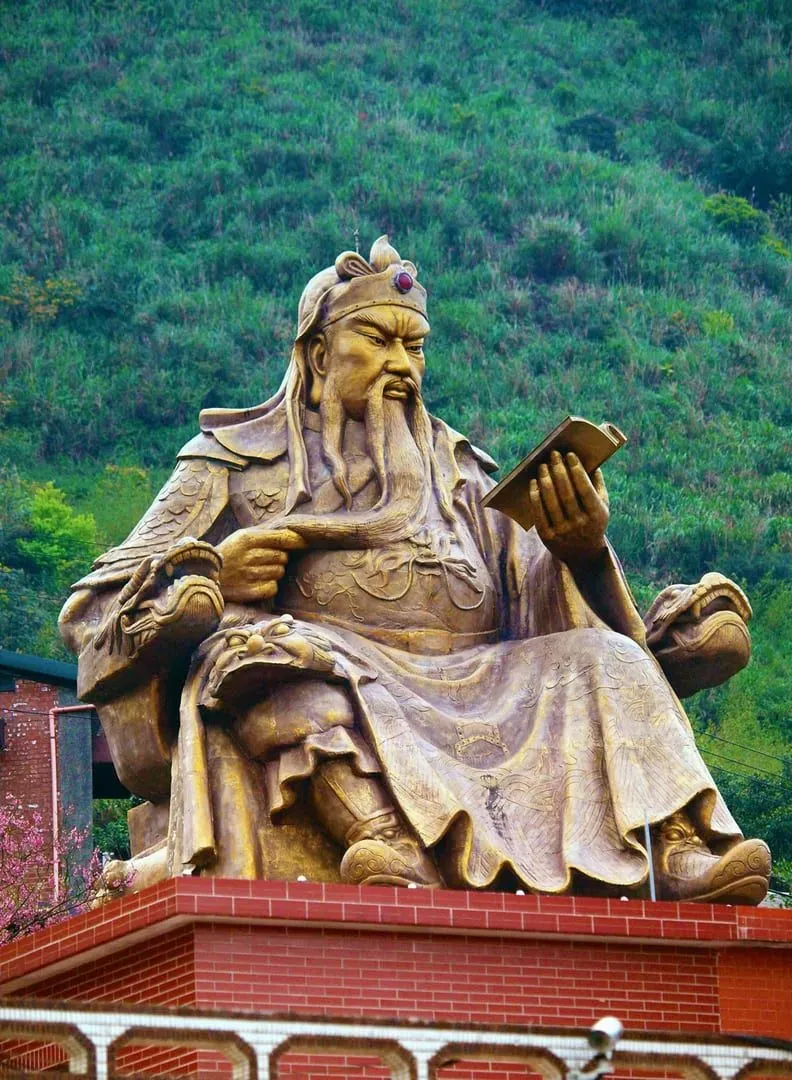
The Guan Yu Shrine (ศาลเจ้ากวนอู) in Hua Thanon is Koh Samui’s main Chinese shrine, built around a 16-metre bronze statue of the Chinese war god Guan Yu. It stands on the Route 4169 ring road about 5 minutes’ drive south of Lamai, entry is free, and it is open daily from about 8:00 to 18:00. It is the island’s centre of Hainanese-Chinese worship.
Most religious sites on Samui are Buddhist temples. This one celebrates the legendary general Guan Yu and the Hainanese immigrants who helped build the island’s economy. The statue is described as the largest bronze image of Guan Yu in Thailand, taller than the roughly 12-metre Big Buddha in the north. With its red facade, dragon motifs and busy atmosphere, it is a colourful break from the beach and temple trail.
The 16-metre bronze statue of Guan Yu is a landmark of Hua Thanon.
Opening Hours, Entry Fee and Location
The Guan Yu Shrine is free to enter and open every day from about 8:00 to 18:00, according to most visitor sources in 2026. A few listings only say “morning to late afternoon”, so arrive before 17:00 to be safe. There is a donation box inside, and you can buy incense and candles for small change.
It is on the main ring road in Hua Thanon, about 5 minutes’ drive south of Lamai Beach and 2 minutes from Wat Sila Ngu. There is parking in front of the shrine. The statue is visible from the road, so it is hard to miss.
Who is Guan Yu?: The God of War and Loyalty
Guan Yu is famous as a general of China’s Three Kingdoms period (about 220-280 AD), later deified as the god of war and loyalty. He is easy to recognise by his bright red face, long black beard and the Green Dragon Crescent Blade. His story is told in the classic novel Romance of the Three Kingdoms (see Guan Yu on Wikipedia).
In Thai-Chinese culture Guan Yu is worshipped as a guardian of loyalty, integrity and business ethics. Many local shopkeepers and entrepreneurs visit the shrine to pray for success and to vow that they will conduct their business with honesty and honor. In Chinese culture and opera, a red face stands for courage and uprightness.
The Bronze Giant: A Record-Breaking Statue
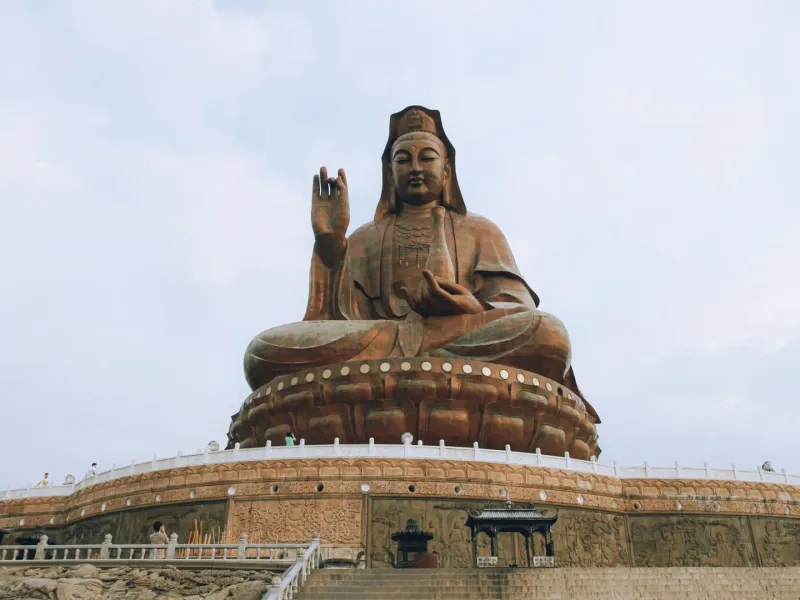
The centrepiece of the shrine is the bronze statue of Guan Yu.
Scale: The statue is 16 metres high. One visitor guide puts the whole structure at nearly 24 metres including the multi-storey red building beneath it; sources differ on what the 16 metres includes, so treat the height as approximate.
The pose: Several descriptions show Guan Yu seated, in the pose of a guardian watching over the south of the island.
The red face: The face is painted red, the traditional sign of Guan Yu’s courage and loyalty.
Details: Look at the armour and base for dragons and traditional Chinese motifs; the base is reported to carry scenes from his life.
History: Celebrating Hainan Heritage
The shrine’s history is tied to 1872, when Hainanese immigrants settled in the Hua Thanon area and set up a small wooden shrine for a Guan Yu image they brought with them. One local history says the wooden shrine was moved to its present site in 1935.
In 2008 the community began a large fundraising drive for a new complex, which opened in January 2016. Today it is the focal point for Samui’s Chinese community, hosting religious festivals and weddings, and donations help pay for its upkeep.
Architecture: Dragons, Gold, and Red Lanterns
The shrine follows traditional Chinese temple style: red walls, gold trim, dragons and lanterns.
The Courtyard
A wide courtyard is hung with red lanterns, which are believed to bring good fortune and ward off bad luck. Metal frames in the courtyard are used for firecrackers during festivals.
The Main Hall
The main hall has a gold altar, brass incense burners and prayer cushions. Red and gold decoration and calligraphy cover the pillars and walls, in sharp contrast to the plain look of many Samui resorts.
The shrine's red-and-gold architecture reflects the island's Thai-Chinese heritage.
Activities: Photography and Culture
Photos: The scale of the statue and the red and gold background make this one of the most photographed spots in the south.
Memorial hall: A small hall displays photographs and objects from the Chinese families who settled in Hua Thanon.
Pay your respects: You can buy incense and candles to offer at the altar. Bowing three times is the traditional gesture.
Weddings: Because Guan Yu stands for loyalty, local couples often hold ceremonies or wedding photos here.
Chinese New Year and Festivals at Guan Yu Shrine
Chinese New Year is the busiest time at the shrine. Local reports describe lion dances, dragon parades, acrobats, firecrackers and fireworks, with processions that “bless” residents and visitors for the year. Chinese New Year 2027 falls on 6 February; exact timings are not published in advance and vary by year. See Chinese New Year on Koh Samui for dates, and the guide to Koh Samui’s Chinese temples for the other shrines. Expect loud firecrackers and crowds on festival days.
Where to Eat: Hua Thanon Chinatown Flavors
The area around the shrine is the old Hainanese-Chinese quarter of the island, with local noodle stalls and market food close by.
Roadside stalls and Hua Thanon market: Noodles, snacks and fresh food within a short walk; prices are typically low, from about 20-150 THB (~0.60-4 USD) a dish.
Lamai restaurants:Sabienglae and other seafood places are a short drive away.
Nearby Attractions
Guan Yu Shrine is a good anchor for a south Samui day:
The shrine sits directly on the Main Ring Road (Route 4169) in Hua Thanon.
By scooter or car: About 5 minutes south of Lamai. Look for the large bronze figure rising above the trees.
By songthaew: Take a songthaew heading south from Lamai or east from Nathon and ask for the “Guan Yu Shrine” or “Chinese temple”.
Parking: There is parking in front of the shrine for cars and motorbikes.
The shrine is a landmark on the road heading south from Lamai Beach.
Best Time to Visit
The shrine is open daily from about 8:00 AM to 6:00 PM.
Time
Experience
Rating
9:00 AM - 11:00 AM
Good light on the statue; cooler air.
★★★★★
12:00 PM - 3:00 PM
Bright and hot; one source calls it the quietest time.
★★★
4:00 PM - 6:00 PM
Softer light; the local market across the road gets busier.
★★★★
Practical Tips for Visitors
Respect the altar: The mood is lively, but it is a place of worship. Avoid blocking people who are offering incense.
Dress code: Cover shoulders and knees. It is usually less strict than at Buddhist wats, and red or bright colours are considered lucky. See temple etiquette on Koh Samui.
Small change: Bring 20 THB notes for incense or a donation.
Explore the back streets: Walk a few minutes into the village behind the shrine.
Ask for history: Volunteers are often happy to share stories if they are not busy.
Who Is the Guan Yu Shrine Best For?
Traveler Type
Rating
Why?
Photographers
★★★★★
Strong colour, scale and architectural detail.
History Seekers
★★★★★
A look at the island’s Hainanese immigrant history.
Foodies
★★★★
Close to Hua Thanon’s local noodle and market food.
Families
★★★★
Kids are often fascinated by the “Giant Red Man” statue.
Guan Yu Shrine: a colourful monument to Samui's Chinese heritage.
FAQ
What is the Guan Yu Shrine in Koh Samui?
The Guan Yu Shrine is a Chinese shrine in Hua Thanon, on the south of Koh Samui, centred on a 16-metre bronze statue of the war god Guan Yu. It serves the island’s Hainanese-Chinese community and welcomes all visitors. Entry is free, and the current complex opened in January 2016.
What is Guan Yu famous for?
Guan Yu was a general of China’s Three Kingdoms period, about 1,800 years ago, later deified as a god of war, loyalty and honesty. He is recognised by his red face and long beard. Many Thai-Chinese shopkeepers pray to him for success and fair trade.
Is there an entry fee?
No. Entry to the Guan Yu Shrine is free. Small donations are encouraged to help maintain the statue and shrine buildings, and you can buy incense and candles for a few baht at the entrance.
Is it taller than the Big Buddha?
Yes. The Guan Yu statue is 16 metres, about 4 metres taller than the roughly 12-metre Big Buddha at Bang Rak. Sources differ slightly on whether the 16 metres includes the base, so the figures are approximate.
Can I visit if I am not Chinese?
Yes. The shrine is open to everyone regardless of background, and it is a welcoming place that shares its heritage with visitors. Dress modestly and avoid blocking people who are making offerings.
How much time should I spend there?
Most visitors spend 30 to 45 minutes on the statue, the main hall and the memorial hall. If you stay for a local meal nearby, plan for about 90 minutes in total.
Travel photographer and island explorer. Mike has spent years documenting Southeast Asia's hidden gems, from secluded beaches to jungle waterfalls.
When to go
The temple calendar
Which day to come
Every day of the week carries its own Buddha posture, and this temple's own festival dates are set out beside it, or the general holy-day rule where it keeps none of its own.
SundayStanding in contemplation
MondayCalming the ocean
TuesdayReclining
WednesdayHolding the alms bowl
Wednesday nightRetreat into the forest
ThursdaySeated in meditation
FridayHands crossed at the chest
SaturdayShielded by the nagaToday
Festivals here
No festival of its own
Wan Phra
Wan Phra, the Buddhist holy day, falls on the new moon, the first-quarter moon, the full moon and the last-quarter moon, roughly every seven to eight days, never on a fixed weekday.
Only the etiquette that applies at this temple, drawn from the island's general rules and narrowed to match its own shoes, dress, fee and quiet requirements.
Cover shoulders and knees
Shoulders and knees stay covered inside every temple, no matter how hot the day, for women and men alike.
Mind your feet
Never point your feet at a Buddha image or a monk; tuck them behind you if you sit on the floor.
Nothing above the Buddha
Never touch a monk's head, and don't reach for anything above a seated Buddha image either.
Women and monks
Women never touch a monk or hand him anything directly; use a cloth or set the item down instead.
Ask before photographing
Ask before photographing a monk up close, and skip the flash and the selfie stick inside a prayer hall.
Keep your voice down
Keep your voice low and your phone silent inside any hall where people are praying or meditating.
Nearby Places
Just past the gate
What's within reach
The nearest beach, temple, waterfall and trail from this gate, each with its real distance and true direction, for whatever comes after this stop.